A Branding
& Creative
Design Agency





My Revolution In Pop Art.
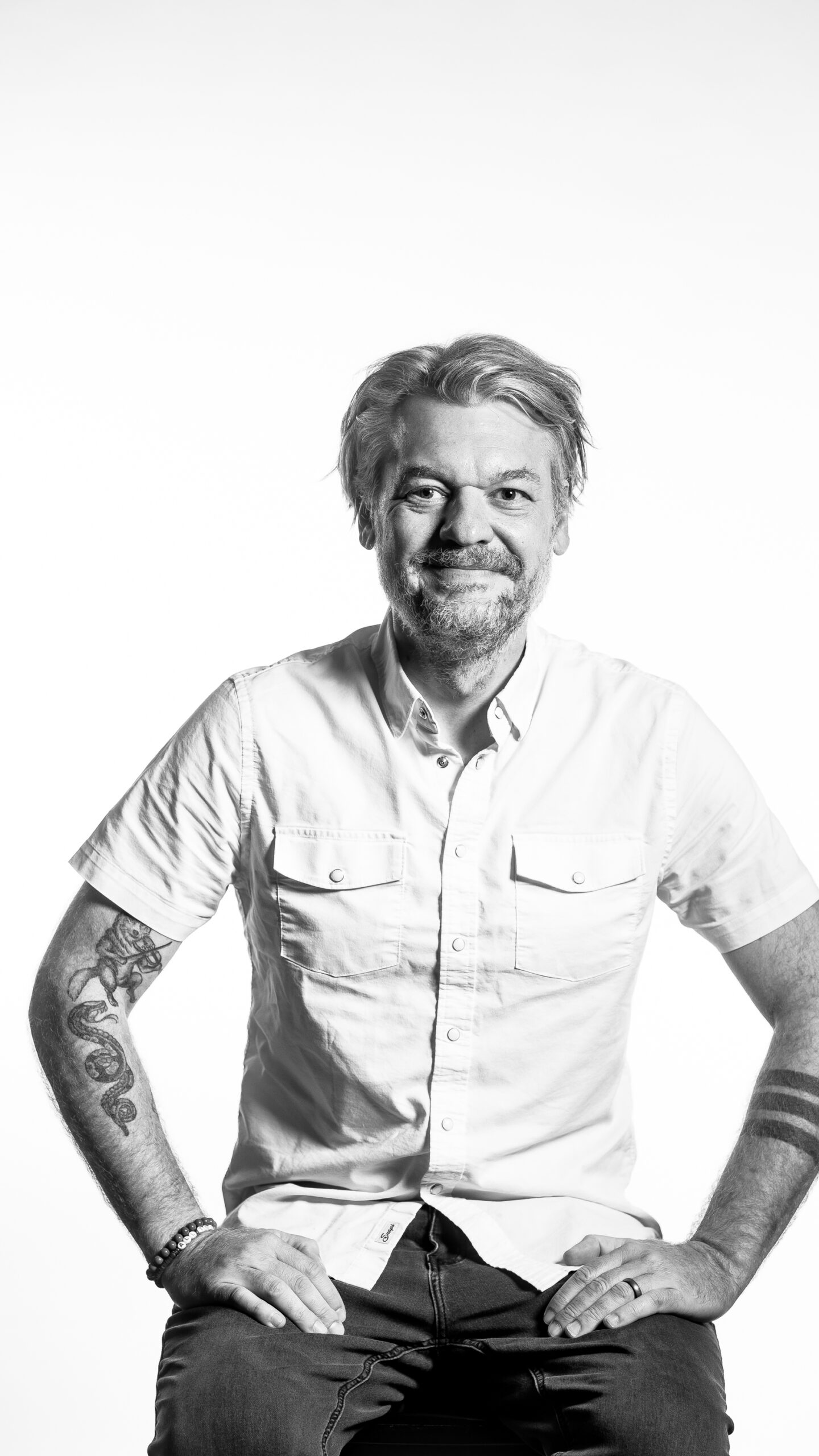
Scott Starr
Principal / Creative Director / Designer / Copywriter
Scott Starr is the founder, principal, and creative director of Rev Pop—guiding the studio’s brand work, visual direction, and storytelling from first concept through final execution.
He also helps steer Rev Pop’s extended creative ecosystem: Super Volta for photo + film production, Manifold Printery for in-house print, and Daresay for long-form editorial storytelling that blends writing, photography, and film.
Alongside the agency work, Scott’s music world lives through Khemitones Records and the studio he built in the woods behind his home.
Outside of work, Scott’s married to his 5th grade crush and is dad to Wilder and Tilly—plus two dogs, Lucy and George. He spent his 20s touring with his rock band and bouncing between coasts in a van, and these days his nights are usually in the recording studio (or RV’ing cross-country with the family). In the summer, you’ll find him by the firepit—and if there’s a plane involved, there’s a good chance it’s headed back to Amsterdam.
Disruption with a Pulse
Rev Pop began as my signature on a series of political pop-art posters I hung around Madison during the Bush years. I had no idea it would grow into a company.
It was a tag — rev your engine — a small, personal revolution in pop art.
Rev Pop meant disruption.
Not the tech kind. The human kind.
I’ve always been wired that way, a daydreaming kid sketching on math tests, getting fired from high school jobs for drawing on time sheets. Call it disruption. Call it creative rebellion. Whatever it was, I couldn’t turn it off.
Art was never something I could separate from anything else. Inspiration’s everywhere. There’s never been a line between art and life; it lives on city streets, not inside screens.
Social media has its place, but it’s blurred the line between strong design and noise.
Inspiration means getting out into the world — Portland, Chicago, New York, LA — wandering through restaurants, hotels, and coffee shops. Noticing wayfinding, signage, bathrooms, wall art. Collecting my own photography along the way.
The question I keep asking: are we filling the world with static, or creating something that makes people stop and really see?
The problem isn’t whether people love your art or hate it. The problem is when they feel nothing at all. If it doesn’t evoke something, it’s futile.
From music to brand design, I wanted to make a living by making cool shit.
Why do restaurant menus have to be boring? Why do insurance logos all use the same shade of blue?
Good design makes everything worth looking at. We’ve forgotten how much aesthetic we absorb every day through websites, street signs, coffee cups, even lamp posts.
Ordinary things don’t have to be mundane. Even a lamp post has design potential. That’s why we still admire relics from eras that cared about how things looked and felt, when practical things were made with intention.
If I’m anti-anything, I’m anti-vanilla execution.
Rev Pop used to have swag that said, “Too Small to Fail.” That’s been our mantra: tight-knit, boutique, bespoke.
I left the big-agency world because I wasn’t able to work directly with the clients I served. A business owner with a big idea deserves to connect with the people responsible for bringing their “baby” to life. Direct contact is non-negotiable. Roadblocks result in work no one responds to.
On some level, immediacy and the muse are intertwined. Artists don’t get to choose when inspiration hits. When ideas start flowing, mine or a client’s, we follow them. Some will land, some will fall flat. That’s not the point. Sometimes it’s the off note, the thing you didn’t love, that leads you to what feels right.
That’s why access is often the shortest route to originality.
Twenty years in, I’ve learned that a small, focused, multi-talented team will always outthink a large, specialized, bureaucratic one. Keeping every stage of the process — words, visuals, photography, video, and print — under one roof gives us control and keeps the vision consistent from first meeting to final deliverable.
One place. One idea. One cohesive story. One cozy creative team.
Our in-house ecosystem wasn’t built overnight. We started with a camera and a cheap printer and scaled up, from Nikon to Hasselblad, HP to Ricoh. I never wanted to become the Walmart of design. Each branch, Super Volta, Manifold Printery, Daresay, deserves its own identity and attention.
It took time, trial, and plenty of growing pains, but it made Rev Pop independent. Our holistic approach is as much about artistic autonomy as it is about creative control.
I shy away from one-off projects because good branding isn’t à la carte; it’s all-encompassing. When a client asks for a logo, it naturally expands into a series of assets that bring their essence to life—a brand with meaning and depth.
Let’s not talk about why you’re different. Let’s show it.
The handle on the door.
The button on Tim’s shirt.
The bag your bagel comes in.
The lighting set to 3600K — somebody designed all of it.
The idea is simple: if someone puts that much thought into the smallest details, imagine the thought behind the product itself. Most people don’t notice, but they feel it. They walk in and think, I want to be here every day. I don’t know why, but this place feels like an extension of me.
What you’re really selling isn’t just a product. It’s an experience, the memory people take with them, and the story they tell when they leave.
Delivering that to our clients means they got their money’s worth, and hopefully, more than they expected. Satisfaction. Excitement. Energy. A sense of completion.
But success isn’t an end state. There hasn’t been, and probably never will be, a peak to what I’ve built or where we’re going. It’s a constant reinvention.
If my dreams have come true anywhere, it’s here: in the freedom to do what I love, to keep creating without feeling boxed in. To grow and evolve within the world I’ve built.
The daydream never retired. It just got louder.

Join Our Headspace
We’re committing to a somewhat sporadic newsletter, where we’re going mental and sharing content that’s helped us get a little closer to being comfortable in the discomfort associated with being creatives and understanding the humanity behind brands.